
OEM Window Sticker API for Any Vehicle by VIN
The Window Sticker API returns an OEM-recreated window sticker for any VIN, including factory MSRP, installed packages, fuel economy, safety ratings, and more. Get structured JSON along with a print-ready PDF and PNG in a single request using a VIN, year, make, and model, or license plate.
Want to see it in action? Try Detailed Vehicle History and get 20% off your first Window Sticker by VIN lookup . Instantly generate accurate, detailed stickers for modern and classic vehicles, no setup required.
Core Features That Power the Window Sticker API
Six reasons automotive platforms choose Vehicle Databases over every other option on the market:

100% OEM Data Accuracy
Build data is pulled from manufacturer records and not estimates.

Covers All Makes and All Models
No brand restrictions. You can get stickers for all vehicle brands.

99.9% Uptime SLA
The API is built for high-volume platforms that cannot afford downtime.

White-Label Ready
Easily retrieve a car manual by VIN or search using year, make, and model.

Batch and Bulk Processing
The API supports bulk requests and can meet your business needs.

RESTful Integration
Full documentation and code examples are available for common languages and frameworks.
What Is a Window Sticker API?
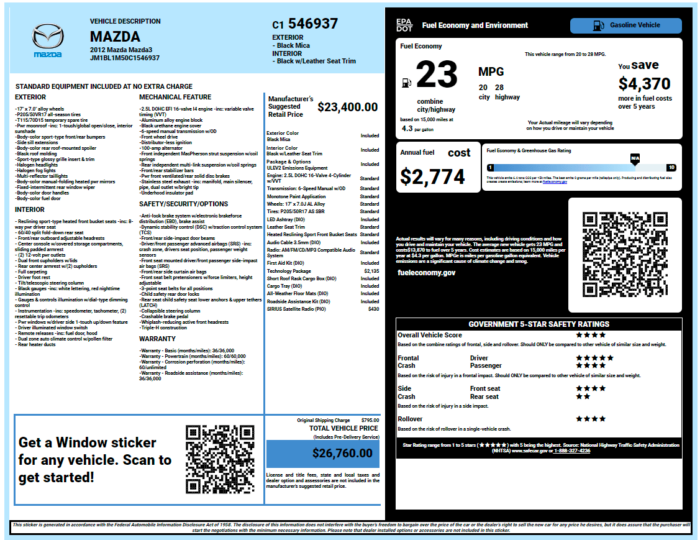
A Window Sticker API accepts a VIN, year, make, and model or U.S. license plate and returns the complete factory build record for that vehicle, formatted as the original Monroney label.
It goes well beyond a basic VIN decoder, returning every factory option, original MSRP and option pricing, EPA fuel economy, NHTSA safety scores, emissions data, and full warranty terms.
Why Does a Monroney Label Matter?
The Automobile Information Disclosure Act of 1958 required every new passenger vehicle sold in the US to display a label showing MSRP, factory-installed options, and fuel economy. That label became the Monroney sticker.
The problem: Once a car leaves the lot, the sticker disappears. By the time it shows up in a used listing or auction lane, the original factory specification is gone. Buyers have no way to verify what packages were installed or what the factory charged for them.
The Window Sticker API fixes this by querying OEM build records tied to the VIN. The factory specs are permanent, and the API shows them on demand.
How a Window Sticker API Is Different from a VIN Decoder
A VIN decoder reads the characters in the 17-digit VIN to return basic identifying info. A window sticker API queries the manufacturer’s actual build database for that serial number, returning far more data.
| Data Point | VIN Decoder | Window Sticker API |
|---|---|---|
| Year / Make / Model | Yes | Yes |
| Trim level | Partial | Full and confirmed |
| Factory-installed options | No | Yes, with option codes |
| MSRP and option pricing | No | Yes, original factory pricing |
| PDF / printable output | No | Yes |
| EPA fuel economy | No | Yes |
| NHTSA safety ratings | No | Yes |
| Warranty details | No | Yes |
How Does the Vehicle Title Check API Work?
Three steps. One API call. No manual lookups, no scraping manufacturer websites, no stitching together data from multiple sources.
Step 1: Submit the VIN
Pass a Vehicle Identification Number to the API endpoint using a standard GET request. You can also call the API with the year, make, and model or US license plate number if the VIN is unavailable.
Step 2: We Decode and Retrieve the Factory Build
The system cross-references OEM build records to identify the exact trim and all factory option codes.
Step 3: Receive Sticker Data Instantly
Your response includes a structured JSON object with every Monroney field, a hosted PDF URL, and a PNG render of the complete window sticker.
Supported Vehicle Coverage
Broad coverage across makes, regions, and model years, with no brand exclusions.
Supported Regions
- United States
- Canada
Model Year Coverage
- Current model year back to 1981 (standard)
- Pre-1981 coverage where OEM records exist
Vehicle Types
- Passenger cars and sedans
- SUVs and crossovers
- Trucks and pickups
- Minivans
- Electric vehicles and plug-in hybrids, including MPGe data
- Luxury and exotic vehicles
Get Window Stickers Without Any Integration
Not every team wants to jump straight into an API. Sometimes you just need the data, quickly and without setup.
If that sounds familiar, you can generate a window sticker right here using the form below. No coding, no configuration, and definitely no delays.
What Data Is Found on a Window Sticker?
A window sticker pulls every vehicle specification together in one place. Here’s a quick look at the key information it includes:
Vehicle Identification
- VIN
- Year, Make, Model, Trim
- Body style, drivetrain
Pricing
- Base MSRP
- Individual option pricing
- Destination charge
- Total MSRP
Factory Standard Equipment
- Interior features
- Exterior features
- Safety systems
Optional Equipment and Packages
- Factory-installed options
- Option codes
- Individual pricing
Mechanical Specifications
- Engine and displacement
- Transmission
- Horsepower and torque
- Towing capacity
Fuel Economy
- City MPG
- Highway MPG
- Combined MPG
- MPGe for electric vehicles
- Estimated annual fuel cost
Safety Ratings
- NHTSA overall rating
- Frontal crash
- Side crash
- Rollover
Emissions
- CO₂ output
- Smog rating
Warranty
- Basic warranty
- Powertrain
- Roadside assistance
- Corrosion coverage
Vehicle Databases Window Sticker API vs. Other Window Sticker APIs
Most OEM window sticker APIs on the market cover a limited subset of brands and years and require you to check brand eligibility before every request. Vehicle Databases is built differently.
| Feature | MonroneyLabels.com API | VinAudit Window Sticker API | Vehicle Databases API |
|---|---|---|---|
| All makes covered | No | Partial | Yes, no exclusions |
| Oldest coverage | Varies by brand | Limited | Pre-1981 across all makes |
| Check coverage before every request | Yes | Yes | No, just submit the VIN |
| Structured JSON output | Partial | Partial | Yes, full JSON + PDF + PNG |
| White-label PDF | No | No | Yes |
| Bulk / batch requests | No | No | Yes |
| Accurate trim detection | No | No | Yes |
The coverage gap is the real problem. With some competitors, even vehicles that fall within their listed brands may return incomplete data, requiring manual inspection to finish the sticker. That kind of uncertainty does not work at scale.
With Vehicle Databases, you submit the VIN and get a complete response. No eligibility checks, no fallbacks, no gaps.
Why Window Sticker Data Matters for Automotive Platforms
Missing factory data has real costs for the businesses involved. Here are six reasons leading automotive platforms treat Monroney data as essential:
1. Buyers Who Cannot Verify Options Walk Away
If a buyer cannot confirm a vehicle has the tow package or premium audio they are paying for, they default to skepticism. That skepticism means lost deals, longer time on lot, and a higher cost per sale.
Businesses that benefit:
- Used car dealerships and online car marketplaces
- Franchise dealers selling CPO inventory
2. Misrepresented Vehicles Create Legal Exposure
The Automobile Information Disclosure Act imposes federal disclosure requirements on dealers. Listing vehicles with inaccurate or missing original equipment data is not just bad for business, but it creates regulatory risk.
Businesses that benefit:
- Franchise and independent dealerships, dealer groups
- DMS and inventory management platforms
3. Inaccurate Option Data Skews Appraisals
A base trim and a fully loaded version of the same model can differ by thousands of dollars. Appraisal tools that guess at the configuration cost dealers profit on overpays and lose customers on underoffers.
Businesses that benefit:
- Instant cash offer and trade-in platforms
- Dealer appraisal tools, F&I, and wholesale valuation software
4. Insurance Total Loss Claims Need Original Build Data
Fleet operators monitor accident history, ownership records, and registration data across large groups of vehicles to maintain accurate fleet records.
Businesses that benefit:
- Insurance carriers and claims departments
- Total loss valuation platforms and appraisal firms
5. Auction Bidders Cannot Bid Confidently Without a Build Sheet
Buyers bidding without confirmed factory specs risk overpaying for a base trim or missing a vehicle with a high-value option package. Showing a copy of the original window sticker alongside listings reduces risk and increases final sale prices.
Businesses that benefit:
- Physical and digital auto auction platforms
- Lease-end valuation tools
6. Refinancing Depends on Accurate Option Valuation
Lenders working from a basic VIN decode miss installed packages and undervalue the vehicle. That produces a worse loan offer for the borrower and a smaller loan opportunity for the lender.
Businesses that benefit:
- Auto lenders, consumer refinancing platforms, credit unions
- Lease-end valuation tools
Why Developers Choose Vehicle Databases’ Window Sticker API
Here is what separates the Vehicle Databases integration experience from every alternative.
Broadest coverage with no brand exclusions
Proprietary trim detection for correct package identification
Dual-output: structured JSON and rendered PDF/PNG in one call
White-label customization on every sticker output
Simple RESTful endpoints compatible with any stack, DMS, or CRM
Enterprise SLA with 99.9% uptime, dedicated support, and volume pricing
Other APIs That Pair Naturally with the Window Sticker API
You can combine the OEM Window Sticker API with other endpoints for a complete vehicle data stack. Some of these APIs are:
Decode any 17-digit VIN to year, make, model, trim, engine, and drivetrain. The foundational lookup layer for any vehicle-facing application.
Retail, trade-in, and wholesale values for any VIN. Built for appraisal tools, pricing engines, and instant cash offer platforms.
Extract VINs, license plates, and vehicle details from images, PDFs, or scanned documents.
Past auction results and realized sale prices across major lanes. Useful for sourcing decisions and wholesale pricing benchmarks.
Factory owner’s manual retrieval by VIN. A natural companion for service platforms and post-purchase customer tools.
Full technical specs by year, make, model, and trim. View engine output, dimensions, towing capacity, payload, and more.
Beyond our standard APIs, we provide custom automotive data solutions designed to fit your exact needs. If your platform needs a specialized dataset or a custom API integration, our team is ready to create the perfect solution for you.
Real Feedback from Teams Using Vehicle Databases’ APIs
Teams across dealerships, marketplaces, and automotive platforms rely on our APIs every day. Here’s what a few of them have shared after putting the data to work in real environments.


Start Generating OEM Window Stickers Today!
Get factory-accurate window sticker data by VIN in seconds. Clean, reliable, and ready to use at scale. Need bulk access for your inventory? Download the full window sticker dataset as a flat file. No integration required.
FAQs About the Window Sticker API
How can I get the original window sticker for a vehicle using the VIN?
You can enter the vehicle’s VIN into the Window Sticker API to retrieve the available vehicle data and generate an OEM-recreated window sticker with details such as MSRP, installed options, packages, equipment, colors, and pricing. The recreated sticker is not the original manufacturer-issued document.
Is there an API to access Monroney sticker data?
Yes, there is an API to access Monroney sticker data. The Vehicle Databases Window Sticker API allows you to retrieve factory sticker details by VIN and returns both structured JSON data and a printable PDF/PNG version of the sticker.
How accurate and official is the data from a window sticker API?
The data from a window sticker API is highly accurate because it is sourced from OEM records tied to the VIN. This means the information reflects the vehicle’s original factory configuration rather than estimated or decoded data.
Can I use this API to generate digital window stickers for used cars?
Yes, you can use this API to generate digital window stickers for used cars. As long as the VIN is accurately entered, the API can recreate the original factory sticker even if the physical label is no longer available.
What’s the difference between a window sticker API and a basic VIN decoder?
The difference between a window sticker API and a basic VIN decoder is the level of detail. A VIN decoder reads the characters in the VIN to return basic identifying information like year, make, model, and engine type, while a window sticker API delivers full factory data, including options, packages, pricing, and a complete sticker output.
Are there APIs for both new and historic model year window stickers?
Yes, there are APIs for both new and classic model year window stickers. The Window Sticker API supports current model years and goes back to before the 1980s.
What industries use a window sticker API?
Industries that use a window sticker API include dealerships, online marketplaces, insurance companies, lenders, auction platforms, and automotive software providers. These teams rely on accurate factory data for listings, valuations, compliance, and underwriting.
What formats are available?
The formats available include structured JSON for integration, along with PDF and PNG versions of the window sticker for display or printing.